
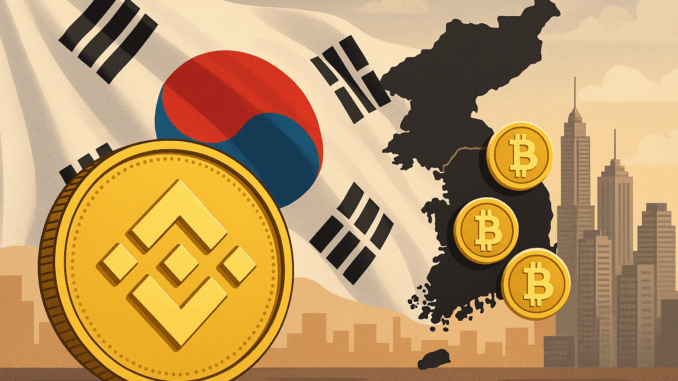

Binance holds a 67% stake in Gopax, acquired in February 2023.
A $4.3 billion US settlement eased regulatory concerns in South Korea.
Gopax faced a $47 million liquidity shortfall linked to Genesis Global Capital.
South Korea is moving closer to allowing Binance back into its crypto market after nearly two years of uncertainty.
The Financial Intelligence Unit (FIU) has resumed its examination of Binance’s controlling stake in the domestic exchange Gopax, signalling that the world’s largest crypto platform may soon regain a foothold in one of Asia’s most tightly regulated markets.
The process centres on an executive-change filing that acts as a substitute for a direct ownership review. If cleared, Binance could regain full access to South Korean traders by late 2025, marking a critical milestone in its Asia strategy.
FIU’s assessment centres on leadership and control
Under South Korean law, regulators evaluate key executive changes rather than shareholder applications for crypto firms. This approach means the FIU’s scrutiny of Gopax’s leadership structure effectively doubles as a test of Binance’s suitability to own a controlling stake.
Binance purchased a 67% interest in Gopax in February 2023, becoming its largest shareholder. However, the approval process was paused amid concerns about anti-money-laundering compliance and the exchange’s legal challenges in the United States.
Those concerns were eased after Binance agreed to pay $4.3 billion in settlements with US authorities in 2023, which has since helped restore regulatory confidence in multiple jurisdictions, including South Korea.
The renewed review suggests regulators are now willing to evaluate Binance’s governance record rather than its legal past. Approval from the FIU would formalise Binance’s control and allow it to re-establish operations under Gopax’s licence.
Gopax’s liquidity crisis and Binance’s rescue effort
Gopax is among the limited number of South Korean exchanges permitted to handle won-denominated crypto transactions, which requires stringent Know-Your-Customer and anti-money-laundering safeguards.
The company faced severe financial strain in early 2023 when its decentralised-finance partner, Genesis Global Capital, halted withdrawals connected to Gopax’s GoFi yield product.
Around $47 million in customer assets became locked, eroding user confidence and liquidity.
Binance’s stake purchase was positioned as a stabilisation plan designed to replenish user funds and restore market trust.
Yet the prolonged approval delay forced Binance to consider selling part of its holding to local technology firm Megazone to meet domestic ownership expectations. The talks eventually fell through in late 2024, keeping Binance’s majority stake intact.
With the FIU now re-examining Gopax’s executive changes, Binance’s role as both investor and potential operator is once again under the spotlight.
Market analysts say the outcome will test whether global crypto exchanges can meet the compliance expectations of a country known for some of the world’s toughest digital-asset rules.
Policy tightening reshapes South Korea’s crypto sector
The FIU’s latest action coincides with a wider regulatory overhaul in South Korea. Authorities recently directed all crypto platforms to suspend retail lending products until a clear legal basis is introduced.
The government is also drafting frameworks for stablecoins linked to the Korean won and preparing to authorise the country’s first spot crypto exchange-traded funds.
Meanwhile, local market leader Dunamu—the operator of Upbit—has launched an institutional custody business that stores client assets exclusively in cold wallets to reduce exposure to cyberattacks.
These shifts highlight how South Korea is moving towards institutional-grade oversight while promoting investor protection through stricter governance.
By resuming the Gopax review, the FIU is signalling that foreign exchanges such as Binance may participate in this maturing landscape, provided they align with domestic compliance standards.
Potential breakthrough for global exchanges in Asia
A successful conclusion to the review could reshape Binance’s position in East Asia.
South Korea remains one of the region’s most active crypto markets by trading volume, and re-entry would strengthen Binance’s regional network following recent regulatory challenges in Japan and the Philippines.
For the South Korean market, a green light for Binance would also mark a symbolic shift—from exclusionary caution to selective engagement with global players that demonstrate regulatory cooperation.
The decision is expected later in 2025 and could serve as a benchmark for how international crypto companies are assessed in other jurisdictions with similar scrutiny requirements.
If approved, Binance’s full return through Gopax would underline a broader transformation: a move towards transparency, tighter controls, and restored confidence in an industry that continues to evolve under government watch.



Be the first to comment